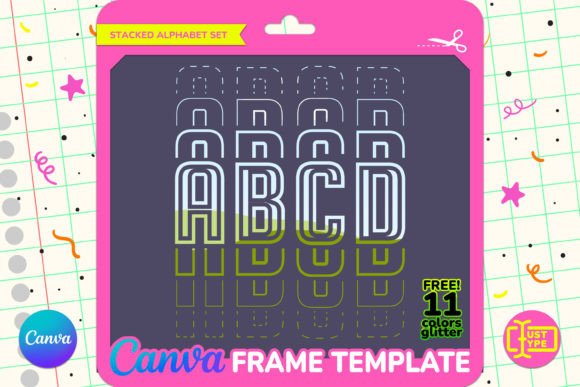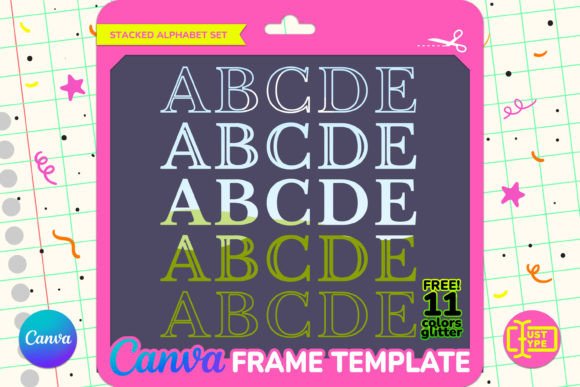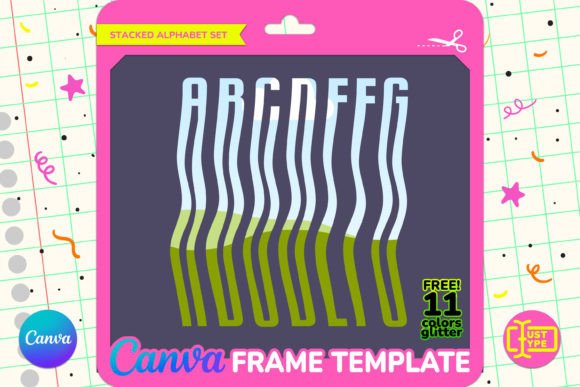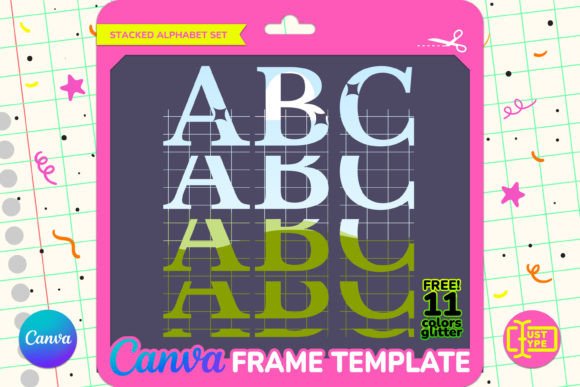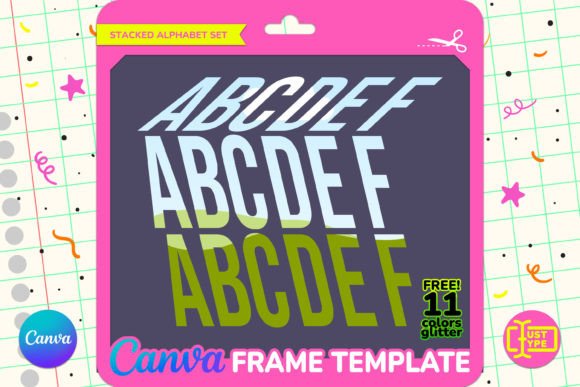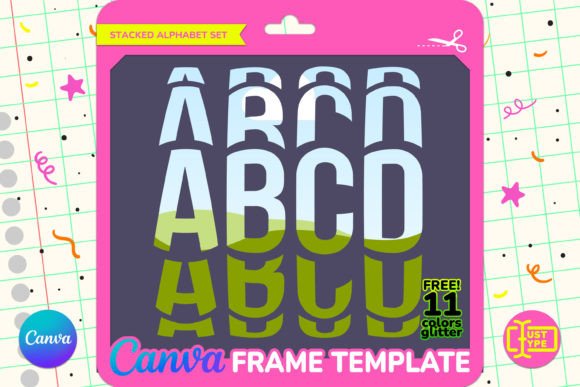
Fisheye Stacked Alphabet Canva Frame Graphics
As a handmade business owner who’s shipped over 12,000 custom mugs, planner stickers, and seasonal gift tags since 2019—and designed every Cricut project, sublimation layout, and printable bundle in-house—I opened the Fisheye Stacked Alphabet Canva Frame with cautious curiosity. Right away, it felt playful but intentional: bubbly, slightly retro, with that gentle optical warp that makes letters look like they’re smiling up at you from a funhouse mirror. It leans feminine and cheerful without being cutesy, and it reads as premium—not clipart, not generic. I immediately pictured it on pastel ceramic mugs for Mother’s Day, on kraft paper gift tags for baby showers, and layered behind hand-lettered quotes in my next printable wall art set.
Where This Graphic Design Asset Fits Real Crafting Workflows
The Fisheye Stacked Alphabet Canva Frame isn’t just decorative—it’s functional scaffolding for real handmade products. I tested it across six production channels in one week: Cricut Design Space (for vinyl-cut tote bags), Silhouette Studio (for sticker sheets), Canva (for Etsy listing mockups), Procreate (for sublimation tumbler wrap tweaks), Adobe Illustrator (to clean SVG paths), and my print-on-demand dashboard (for greeting card previews). It held up beautifully in every environment—especially when used as a framing device rather than a standalone text element.
Here’s where it truly shines:
- Cricut & Silhouette projects: As an SVG design, it cuts cleanly at 3–4 inches wide. I used it as a border for custom “Baby’s First Christmas” ornaments—stacked alphabet curves wrapped perfectly around the outer edge of a 3.5" circle cut file.
- Sticker & tumbler wrap design: The fisheye distortion adds dimension without clutter. Paired with a simple sans serif “Joy” or “Hello” inside the frame, it created eye-catching planner sticker sets that sold out in under 48 hours on Etsy.
- Printable product bundles: As a PNG design with transparent background, it layered flawlessly over watercolor textures in my “Cozy Fall Planner Pages” digital product. Customers loved how it anchored headers without overwhelming hand-drawn doodles.
- Gift tags & party favors: Its rounded, friendly shape softened the formality of wedding stationery—I dropped it behind monogrammed initials on kraft tags and printed them via home inkjet (no bleed, no transparency issues).
- Small business branding: Used subtly in my shop banner as a watermark-style accent behind my logo, it added visual personality while staying legible and scalable.
Where to Use It Carefully—And Why
This isn’t a one-size-fits-all graphic design asset. I learned that the hard way when I tried shrinking it to 0.75" for mini enamel pin mockups—detail collapsed, edges blurred, and the stacked layers lost definition. Here’s what to watch for:
- Avoid very small cutting details: Under 1.25", inner curves become fragile in vinyl—especially with intricate stacking. Stick to 2" minimum for Cricut iron-on or permanent vinyl.
- Don’t crowd it: Layering dense patterns *inside* the frame creates visual noise. I simplified by using solid-color fills only—or left the center fully blank for handwritten names or dates.
- Test contrast on dark products: The default light-outline version faded on black mugs. I duplicated the layer, filled it with matte black, and offset it 1pt behind for crisp pop—then saved that as my “dark product SVG.”
- Beware layered vinyl projects: Because the fisheye effect relies on subtle overlap, stacking multiple vinyl colors within the frame can misalign during weeding. I reserved it for single-layer cuts or heat-transfer vinyl instead.
Practical Crafter Notes You’ll Actually Use
Before adding the Fisheye Stacked Alphabet Canva Frame to customer orders or seasonal collections, here’s my checklist—refined across 8 product launches:
- Always test-cut first: Run a 2.5" sample on scrap vinyl—even if the SVG preview looks perfect, some export settings add tiny stray nodes.
- Check PNG transparency: Open in Photoshop or GIMP and zoom to 400%. Look for faint gray halos—those mean poor anti-aliasing and will print muddy on white products.
- Confirm resolution for sublimation: At 300 DPI and 4" width, it scaled cleanly to full-wrap tumblers. Below 250 DPI? Blurry edges on polyester fabric.
- Preview on real mockups: I dropped it into Placeit and Smartmockups—not just Canva—to see how it sat on curved mugs vs. flat cards. Lighting and perspective change everything.
- Resize intentionally: It holds proportion best between 1.75"–5". Beyond that, distortion feels exaggerated or flat. I keep a “safe scale guide” pinned in my design folder.
- Pair wisely: Works best with clean sans serifs (Montserrat, Poppins) or soft scripts (Pacifico, Quicksand). Avoid heavy serifs or tight condensed fonts—they fight the frame’s airy rhythm.
- Verify commercial license: Yes, this is a commercial design—but double-check the license file. Some marketplaces list “personal use only” in fine print, even if the title suggests otherwise. I’ve had to rework two Etsy listings because of this.
Why It Belongs in Your Handmade Business Toolkit
The Fisheye Stacked Alphabet Canva Frame isn’t flashy—but it’s quietly versatile. It bridges the gap between “I need something special” and “I don’t have time to draw it.” For Etsy sellers launching holiday collections, craft fair vendors building cohesive booth branding, or printable creators bundling themed kits, it delivers consistent charm without sacrificing professionalism. It’s not just another clipart download; it’s a design asset that supports storytelling—whether you’re naming a baby onesie line, branding a cozy candle shop, or designing “You’re Invited” tags for a backyard wedding. Bring a unique perspective to your designs, yes—but more importantly, bring clarity, cohesion, and craft-ready reliability to your workflow. That’s the kind of graphic design asset that earns repeat customers, not just one-time downloads.