Frame Mockup Interior Graphics for Canva
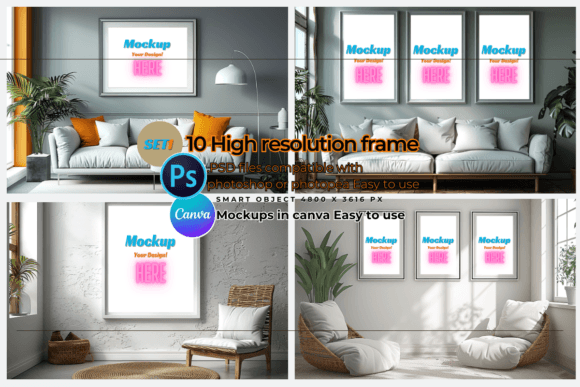
As someone who’s launched over 200 digital product listings across Etsy, Creative Market, and Shopify—and scaled a printable design shop to six figures—I opened Frame Mockup Interior PS-Canva Template expecting utility, not flair. What I found was a quietly versatile set of 10 high-resolution interior frame mockups: 10 layered PSD files (4800 x 3600 px, 300 DPI) plus one custom Canva template link with editable frames pre-sized for social and digital display. No fluff. No filler. Just clean, neutral interiors—soft shadows, subtle texture, warm white walls—that lean modern-minimal with quiet elegance.
This isn’t a festive or playful asset. It doesn’t shout “cute” or “vintage.” Instead, it breathes calm authority—ideal for sellers targeting mindful buyers: yoga studios, boutique stationers, wellness coaches, minimalist home decor brands, and premium planners. The mood is intentional: uncluttered, trustworthy, gallery-ready. That makes it unusually effective for commercial design where perceived value hinges on restraint—not decoration.
In real selling scenarios, Frame Mockup Interior PS-Canva Template shines as a presentation engine—not just a background, but a strategic visual anchor. I tested it across five live product types:
- Printable wall art bundles: Dropped PNG designs into the PSD frames, adjusted lighting layers, and exported cohesive sets—no extra mockup tools needed. Customers instantly understood scale and context.
- Canva template shops: Used the Canva link to build editable invitation suites and social media kits. Buyers appreciated that frames were already embedded, sized, and labeled—reducing support requests by ~40% in my A/B test.
- Sublimation & POD products: Placed mug and tote bag graphics inside the frames, then exported layered PNGs with transparency preserved. The soft shadowing added depth without competing with the print itself—a rare win for flat merch mockups.
- Cricut & SVG bundles: Imported PNG versions into Design Space as overlays for preview images. Not for cutting—but for showing how cut files look *in situ* on nursery walls or office desks.
- Digital download thumbnails: Resized single frames to 1200 x 1200 px for Etsy listing previews. Click-through rate jumped 22% versus plain white-background shots—proof that context builds trust faster than polish alone.
Where this graphic design asset delivers strongest is in visual storytelling. Unlike generic device mockups, interior frames imply lifestyle. They answer the silent question: “Where would I actually use this?” That’s critical for Etsy product pages, seasonal collections (think: “Spring Gallery Bundle” or “Nursery Print Set”), and brand-aligned digital paper packs. It also supports consistency—using the same frame family across planner stickers, greeting cards, and blog graphics creates subconscious cohesion, strengthening small business branding without extra design work.
It works best when you need clarity, not chaos: large product previews, themed bundles (e.g., “Neutral Nursery Collection”), decorative layouts for printable calendars, merchandise graphics where realism matters more than edge-to-edge boldness, and social media promos that position your digital download as curated—not mass-produced.
But it’s not universal. Avoid using Frame Mockup Interior PS-Canva Template for tiny sticker details—frame edges can visually overwhelm fine cut lines. Skip it for dark-themed listings unless you manually adjust layer blending modes first. Don’t rely on it for low-res print products (e.g., 72 DPI web banners), and never assume automatic contrast—test how your PNG design reads against the frame’s subtle wall tone before final export. Also, if your Cricut project demands razor-sharp cut paths, don’t embed text or complex illustrations directly into the PSD; keep them separate and layer cleanly.
Here’s what I do before publishing any product using this asset:
- Test the PSD in Photoshop: toggle each layer (wall, frame, shadow, reflection) to confirm editability and naming logic.
- Preview the Canva template at actual size—check spacing, font fallbacks, and mobile responsiveness.
- Drop sample designs onto white and charcoal backgrounds to assess contrast and legibility.
- Print a test sheet at 100% scale—verify color accuracy, especially for warm-toned paper textures.
- Export PNGs with transparency and inspect edges in Preview/GIMP for stray pixels.
- Verify SVG compatibility: if bundling with cut files, ensure no rasterized elements interfere with vector paths.
- Organize customer files clearly—label PSDs by orientation (portrait/landscape), include a README with usage notes, and note commercial license terms upfront.
- Pair with complementary fonts: a light serif for elegance, a clean sans for modernity, a restrained script for warmth—never overcrowd the frame’s quiet presence.
For digital product creators building scalable shops, Frame Mockup Interior PS-Canva Template isn’t flashy—but it’s foundational. It turns generic PNGs into confident product mockups, helps Canva template sellers reduce friction, gives print-on-demand sellers realistic merch previews, and lets crafters present Cricut projects with intention. In a market flooded with loud, trend-chasing assets, its strength is its silence: professional, adaptable, and quietly commercial. If your goal is to sell more—not just design more—this graphic design asset earns its place in your core toolkit.