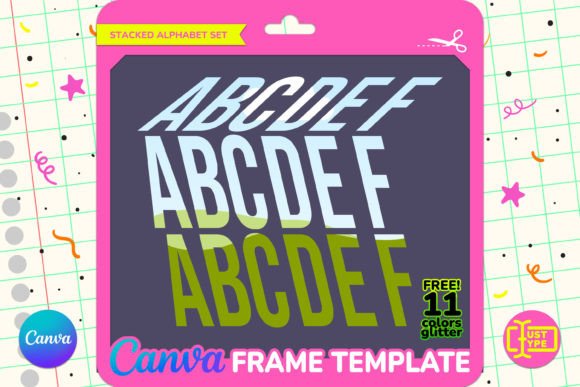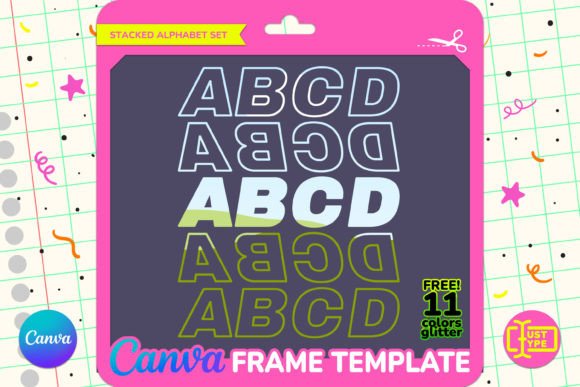
Reverse Stacked Alphabet Canva Frame
A Designer’s First Look: Playful, Precise, and Purpose-Built for Stitching
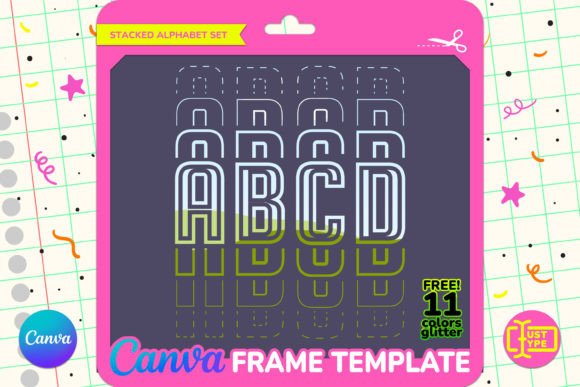
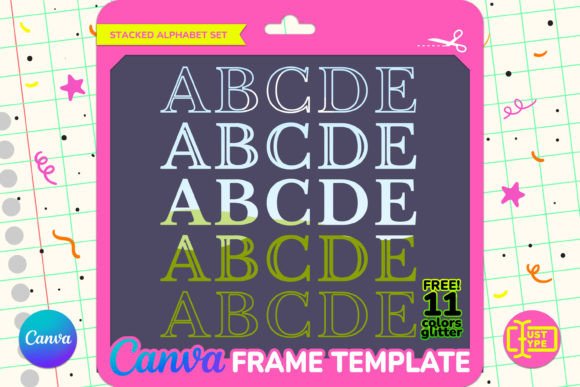
When I opened the Reverse Stacked Alphabet Canva Frame, my immediate thought wasn’t “cute” or “trendy”—it was “this will hold up.” The stacked letters flip vertically with clean geometry and intentional negative space between layers. It feels less like a decorative overlay and more like a structural design system—each letter acts as a container, not just a shape. That matters. In embroidery, containers become stitch zones. And zones need breathing room.
Real-World Test: A Custom Embroidered Tote for a Local Bakery
Last week, I used the Reverse Stacked Alphabet Canva Frame to build a logo-style monogram for “Hearth & Crumb,” a small-batch bakery launching branded canvas totes. I dropped their wheat icon into the “H” and a minimalist coffee bean into the “C.” The result? A balanced, legible composition that translated cleanly from screen to hoop. But here’s what surprised me: when stitched on midweight natural canvas with 40-weight rayon thread, the reversed stacking created subtle visual depth—like shadowed letterforms—not flat silhouettes. Customers noticed it instantly. One said, “It looks hand-drawn, but sharp.” That’s the sweet spot: handmade warmth with professional polish.
Where This Design Shines (and Where It Asks for Extra Care)
The Reverse Stacked Alphabet Canva Frame excels in projects where clarity, charm, and customization intersect:
- Custom apparel: Works beautifully on sweatshirt chests and tote bag fronts—especially when paired with low-density fill stitches and minimal satin borders.
- Baby embroidery: Its open structure avoids dense stitching that could irritate sensitive skin; ideal for onesies and burp cloths when scaled to 3–4 inches tall.
- Embroidered patches: The stacked layout gives instant dimension without needing complex layering—great for iron-on or sew-on badge-style accents.
- Holiday embroidery: Swap in snowflakes, holly, or tiny ornaments for festive kitchen towels or stocking cuffs.
- Etsy listings and craft fair products: Buyers respond to designs that feel both personal and polished—and this frame delivers both, especially when you add your own texture or motif.
But be thoughtful about context. On stretchy fabric like ribbed knit tees, avoid tight curves at letter corners—the reverse stack can exaggerate distortion if hooping isn’t precise. On dark fabric, test contrast early: some inner letter spaces may vanish unless you use a light stabilizer or add subtle underlay. And on curved surfaces like caps, keep the full frame under 3.5 inches wide—tighter stacks compress poorly in the front panel curve.
Stitching Realities: What You’ll Actually See on the Finished Product
This isn’t a “drop-in-and-stitch” file—it’s a design framework. That means your choices directly impact the final machine embroidery design quality. I found the best results came when:
- I used medium tear-away stabilizer (not cut-away) to preserve the airy feel of the stacking;
- I reduced overall stitch density by 10–15% in fill areas—dense fills flatten the layered illusion;
- I chose thread colors with clear value contrast between layers (e.g., charcoal for the base letter, oatmeal for the reversed top);
- I avoided placing fine details—like tiny icons—in the narrowest vertical gaps between letters, where thread tension can cause skipped stitches.
On thin fabric like linen tea towels, I added a lightweight fusible backing first. Without it, the reverse effect looked slightly blurred—not wrong, but softer than intended. For commercial embroidery, that softness might read as unrefined. For a boutique nursery pillow cover? It adds gentle character.
Why This Matters for Your Craft Business
If you sell handmade products—or plan to—you’re selling perception as much as function. The Reverse Stacked Alphabet Canva Frame elevates perceived value because it signals intentionality: someone didn’t just slap text on fabric—they built something with spatial awareness. That builds customer trust, especially for personalized gifts where buyers pay more for uniqueness.
For Etsy sellers and small shop product lines, it also supports brand consistency. Use the same frame across your packaging tags, embroidered aprons, and social mockups—it creates quiet cohesion. And because it’s built in Canva, you can generate clean printable mockups fast: no need to hire a designer for every variation.
Practical Designer Notes Before You Stitch
Before using the Reverse Stacked Alphabet Canva Frame in any embroidery project, do these five things:
- Test on scrap fabric—same weight and weave as your final piece;
- Check thread color contrast in both natural and artificial light;
- Review stitch density in your embroidery software—look for overfilled corners or thin outlines;
- Confirm hoop size compatibility—some stacked layouts push width limits on 4×4 hoops;
- Inspect small details at 200% zoom in your editing view—what looks crisp on screen may collapse when stitched.
Also: always test in black-and-white mockups. If the design loses its hierarchy without color, reconsider your layout or add subtle outline stitches. And if you plan to sell the finished product commercially—or offer the digital embroidery file as a standalone asset—verify licensing terms. Not all Graphics in Canva are cleared for resale, even when customized.
The Bottom Line for Makers Who Stitch With Intention
The Reverse Stacked Alphabet Canva Frame isn’t flashy—but it’s quietly capable. It won’t wow with glitter or gradients, but it delivers reliability, adaptability, and a distinct sense of crafted rhythm. It fits naturally on an embroidered apron for a ceramic studio, a holiday tea towel set, or a baby’s first-name patch—because it respects fabric, thread, and human eyes alike.
If your work lives at the intersection of custom apparel, craft business, and thoughtful detail, this frame earns its place in your active design toolkit. Just remember: great embroidery starts long before the needle drops. It starts with choosing tools that understand what stitch, fabric, and intention really ask of each other.